


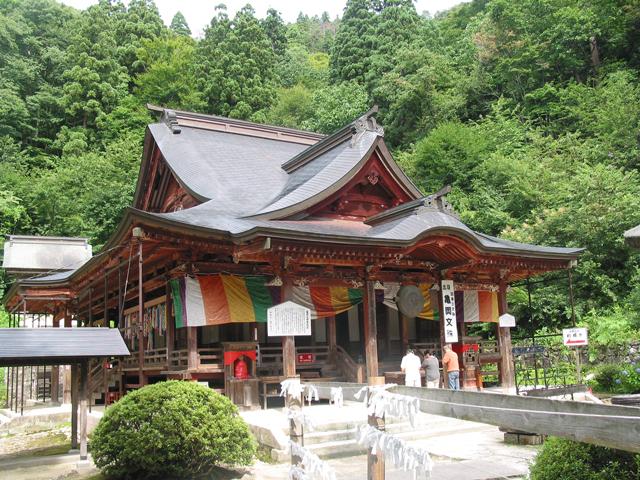
Kameoka Monju-do Temple
2011年11月17日

				<a href="https://qnsmjrftzzddmdtbzmih.supabase.co/storage/v1/object/public/site-images/articles/takahata/log-257865-01.jpg" target="_blank"><img src="https://qnsmjrftzzddmdtbzmih.supabase.co/storage/v1/object/public/site-images/articles/takahata/log-257865-01.jpg" style="max-width:480px;" alt="Kameoka Monju-do Temple: Image"></a>


			</div>


										<p>
				Kameoka Monju is famous as one of the Three Great Monju Temples of Japan, alongside Kiredo Monju in Tango (Kyoto) and Abe Monju in Yamato (Nara).<br>
It is said that the Monju-do Temple originated in 807 (Daido 2) when the venerable Tokuitsu, who visited this area to spread Buddhism in the Tohoku region, was moved by the mountain's resemblance to Mount Wutai and erected a temple.
The betto (head priest) and Daishoji Temple belong to the Shingon sect. As an imperial prayer temple, they were commanded to offer prayers for national peace and security. Furthermore, for ten generations, from Tokugawa Tsunayoshi, the 5th Shogun, until Iemochi, they were granted 100 koku of shuin-chi (land bearing the shogun's vermilion seal) and received treatment equivalent to a Chunagon (Middle Counselor), establishing themselves as one of the most renowned temples in the country.
Monju-do Temple enshrines Monju Bosatsu (Manjushri), the bodhisattva who presides over wisdom and sits to Shakyamuni's left. In China, Mount Wutai is considered his pure land. As the saying goes, 'If three people gather, they have the wisdom of Monju,' Monju is known as the god of academic success. A constant stream of visitors comes to pray for success in entrance exams for schools and companies.
Within the temple grounds, ancient cedar trees flourish, and a sense of historical weight and solemnity permeates the air. Daishoji Temple's main hall enshrines Dainichi Nyorai as its principal image, alongside a wooden standing statue of Sho Kannon Bosatsu (Holy Avalokitesvara) made with cypress Yosegi-zukuri (joined-woodblock technique) and urushi-haku (lacquer and gold leaf) (prefecturally designated), and two statues of Amida and Yakushi Nyorai. All are believed to be works from the Kamakura period. It is said that if you visit Monju-son and go before Daikokuten beside it, embrace the statue with both hands, and pray, 'Become light,' it will gradually become lighter; if you pray, 'Become heavy,' it will become heavier; and if your wish is granted, you will be able to lift it lightly.
At the entrance to the approach path stands the Nio-mon Gate, with Kongo Rikishi statues on either side. Along the approach path are statues of the Sixteen Rakan, a haiku monument by Basho, and a Nembutsu monument dedicated to the righteous citizen Takanashi Riuemon, inscribed with 'Namu Amida Butsu.' In addition to the Haraikawa Yakushi-do Hall, which enshrines Yakushi Nyorai, Dainichi Nyorai, Fugen Bosatsu, and Kokuzo Bosatsu are enshrined behind the Monju-do Hall, and Zao Gongen, the guardian deity of the entire mountain, is also enshrined there.
Taking a break at a teahouse and eating the famous konnyaku is also one of the pleasures of visiting 'Monju-sama.'