


お知らせ
Hyuga Cave
2011年11月17日

				<a href="https://qnsmjrftzzddmdtbzmih.supabase.co/storage/v1/object/public/site-images/articles/takahata/log-257872-01.jpg" target="_blank"><img src="https://qnsmjrftzzddmdtbzmih.supabase.co/storage/v1/object/public/site-images/articles/takahata/log-257872-01.jpg" style="max-width:480px;" alt="Hyuga Cave: Image"></a>


			</div>


										<p>
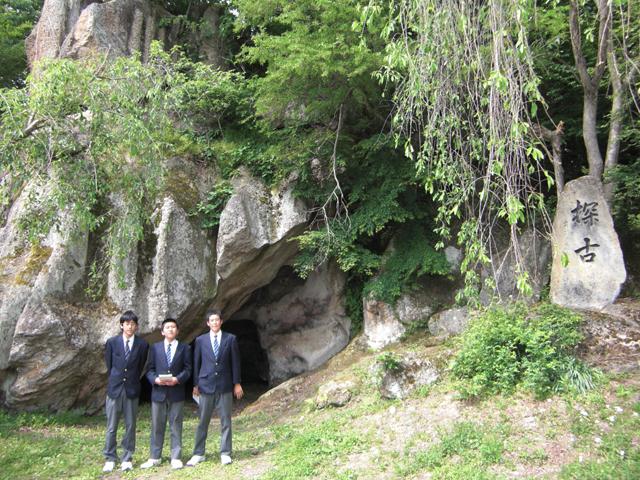
				During the Edo period, this cave, deep in the forest, was said to be a forbidden place, known by everyone as the 'Demon's Dwelling', where entry was prohibited. Over time, it gradually began to catch the public's eye, and people started to appear, picking up stone arrowheads and other artifacts.<br>
The cave is part of an archaeological complex located at the foot of Mount Tateishi, at an elevation of 230m, consisting of the 4th rock shelter, 1st cave, 2nd cave, and 3rd rock shelter from the west. Since the autumn of Showa 30 (1955), archaeological excavations have been carried out on four occasions under the guidance of Dr. Tadao Yamauchi, professor at the same university, and Professor Ryokichi Kashiwakura of Yamagata University. As a result, it was discovered to be a complex site that had been used for thousands of years. Specifically, the central 1st cave is a gourd-shaped cave with an entrance 3.5m high, 5m wide, and 14m deep. The sedimentary layer in front of the cave is over 2m thick. Among the five basal layers, the topsoil of the 1st layer contained artifacts from the late Jomon period onwards. The 2nd layer contained items from various periods, from the late Jomon to the incipient Jomon period, and the lowest layer contained artifacts from the incipient Jomon period. The pottery (e.g., raised-line pattern pottery fragments, nail-impressed pottery fragments) and stone tools (e.g., stone spears, grinders, stone axes, etc.) from these layers are considered extremely important archaeologically for elucidating the developmental process from Paleolithic culture to Jomon culture. (In addition, numerous bones of humans, bears, deer, foxes, ducks, pheasants, and others were excavated.) The existence of the incipient Jomon period (around 10,000 years ago) became nationally known and was highly praised by academic societies. <br>				</p>