


フォトギャラリー
Akutsu Hachiman Shrine
2007年3月4日

<a href="https://qnsmjrftzzddmdtbzmih.supabase.co/storage/v1/object/public/site-images/articles/takahata/log-67812-01.jpg" target="_blank"><img src="https://qnsmjrftzzddmdtbzmih.supabase.co/storage/v1/object/public/site-images/articles/takahata/log-67812-01.jpg" style="max-width:480px;" alt="Akutsu Hachiman Shrine: Image"></a>
</div>
<p>
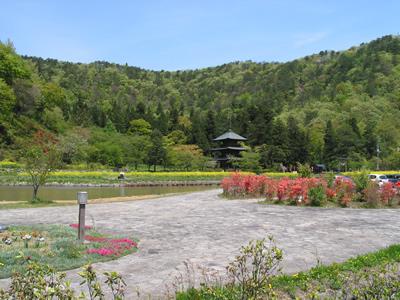
Akutsu Hachiman Shrine is said to have originated in the 2nd year of Jōgan (860 CE) when Jikaku Daishi, with the cooperation of the powerful local figure Akutsu Iwasaburō, built an Amitābha hall. Later, during the late Heian period, Minamoto no Yoshiie is said to have invited a branch of Tsurugaoka Hachiman Shrine in Kamakura to pray for victory during the pacification of Ōshū, but this is not certain from the outset. Surrounded by lush trees, to the left of the entrance to the moss-covered stone path leading to the shrine, stands a beautiful three-story pagoda, a Bugaku hall along the path, and the main hall beyond that. These three structures are designated cultural properties of the prefecture.<br> The three-story pagoda was rebuilt in the 9th year of Kansei (1797) through donations from farmers, and its initial construction is said to have been in the 2nd year of Kan'ei (1625). It is a three-bay square structure with a copper-plate roof, and is the only multi-story pagoda in the Okitama region. The Bugaku hall is said to date from the late Muromachi period, a single-bay square structure with a pyramidal roof and thatched roof. Every year on May 3rd, the Yamato-mai dance is performed with elegance, and on September 15th, the Ennen-no-mai dance is performed, both in rich ancient style. The main hall is a three-bay nagare-zukuri style with a thatched roof.<br> Within the shrine grounds, there are a bell tower, Hinenmatsu, and the remnants of a Yabusame target range. Scattered across the entire back hill are over ten tumuli of the Akutsu Kofun Group (Torii-cho district). Additionally, there are other features such as the Sennenmatsu (Town Designated Cultural Property), caves in the Oku-no-in, and legends remain about Kataha no Fuki, Jiji Baba Ishi, and Kōbō Shimizu. It is located east of the town's historical park, and the mountain to the west of the shrine is adorned with about 5,000 azaleas. To the east of the shrine grounds is a local history museum. Furthermore, the surrounding area has been developed as a historical park, and a prefectural archaeological museum serves as a core facility of the "Ukitamu Fudoki-no-oka" (Ukitamu Hills of Ancient Records).<br><br>※Jikaku Daishi − A Tendai sect monk, Ennin. He studied at Mount Wutai in Tang China and became the 3rd chief abbot of Enryaku-ji Temple. He passed away at Yamadera Risshaku-ji Temple.<br><br>○<a href="http://maps.google.co.jp/maps?f=q&hl=ja&q=%E5%AE%89%E4%B9%85%E6%B4%A5%E5%85%AB%E5%B9%A1%E7%A5%9E%E7%A4%BE&layer=&ie=UTF8&z=15&ll=38.010805,140.219064&spn=0.016163,0.029182&om=1&iwloc=addr" target="_blank">Google Maps</a> </p>